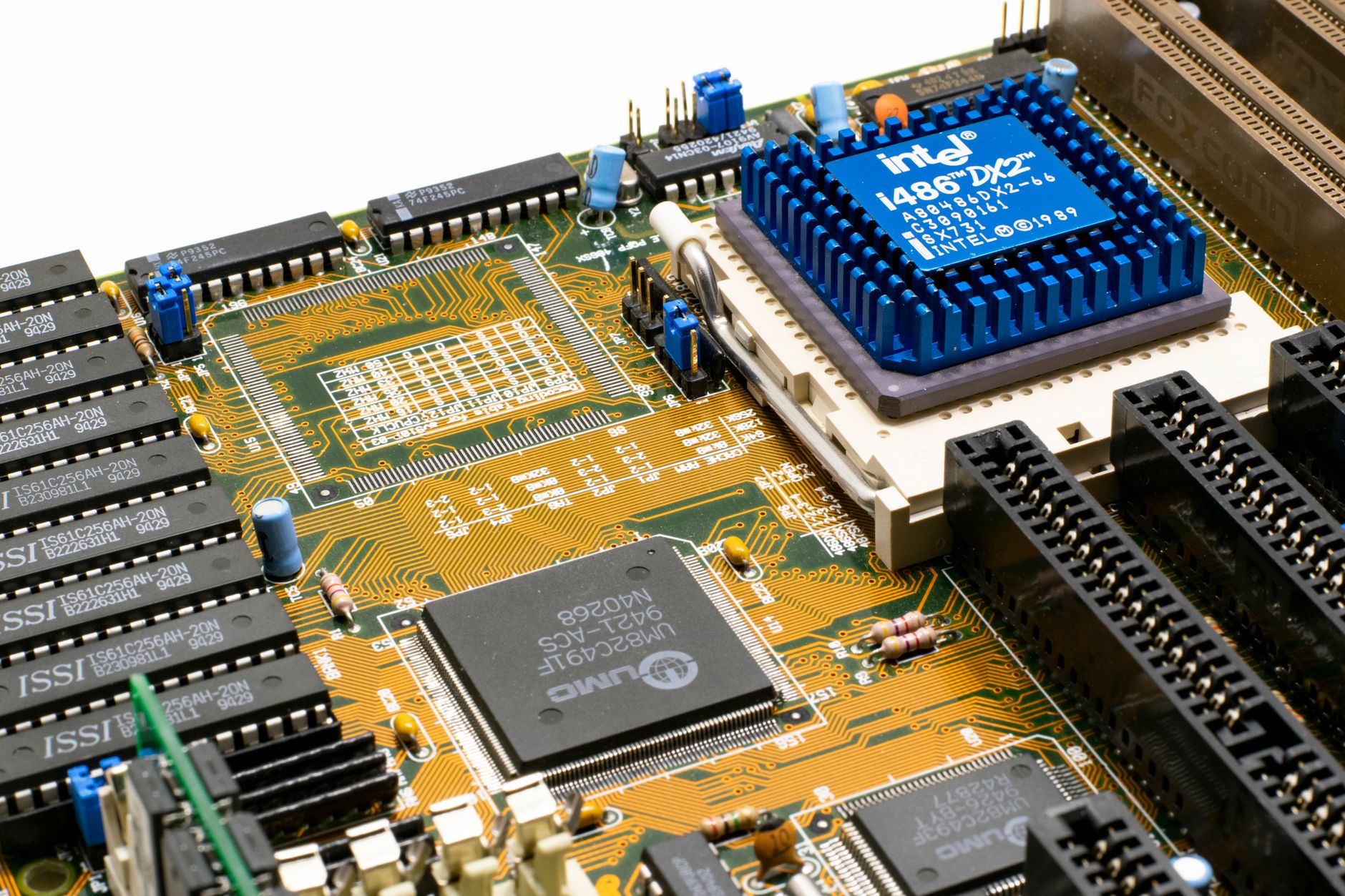
The Rally Everyone Misread
Intel’s April 23rd earnings beat—revenue up 9% YoY, gross margins expanding to 44.2%, and guidance raised for Q2—triggered the stock’s largest single-day gain since 2001. Wall Street analysts upgraded en masse. The narrative: American manufacturing is back, the foundry business is viable, and Intel’s 18A process node is competitive with TSMC’s 2nm.
But zoom out from the earnings call theatrics and a more consequential pattern emerges. Intel is executing a $100B+ capital expenditure plan across Arizona (two fabs), Ohio (two fabs), New Mexico (upgrades), and Germany—the largest private construction project in U.S. history. The CHIPS Act kicked in $8.5B in grants plus $11B in loans. Sounds like a win.
Here’s what the 16% stock surge obscures: not a single one of these greenfield fabs will reach high-volume manufacturing (HVM) before Q3 2027. Intel’s Arizona Fab 52 targets late 2027 for 18A volume production. Ohio’s sites won’t break ground on equipment installation until 2028. Meanwhile, 68% of U.S. advanced chip consumption—the sub-7nm processors running AI training clusters, F-35 avionics, and autonomous vehicle stacks—still comes from TSMC’s Fab 18 in Tainan, Taiwan.
The timing gap isn’t a bug. It’s the entire geopolitical story.
The 36-Month Vulnerability Window
Let’s decompose what “2027-2028 HVM” actually means for strategic industries:
Defense & Aerospace: The Pentagon’s 2025 supply chain audit (leaked excerpts published April 20) identified 147 weapons systems with single-source dependencies on Taiwan-fabbed chips. The F-35’s Northrop AN/APG-81 radar? TSMC 5nm. The Army’s Integrated Visual Augmentation System (IVAS)? Samsung Korea, same risk profile. Raytheon’s LTAMDS missile defense radar won’t migrate to Intel 18A until 2029 at earliest, per their March investor day.
Automotive: GM, Ford, and Stellantis collectively consume 847 million automotive-grade chips annually. 61% come from East Asia (mostly TSMC, Samsung, and legacy nodes from China’s SMIC). Intel’s automotive roadmap doesn’t list HVM capacity for ADAS/EV chips before 2028. That means every new EV platform designed in 2026-2027 locks in another 7-year dependency on cross-strait supply chains (typical automotive chip lifecycle).
AI Infrastructure: Here’s the kicker. Nvidia’s Blackwell and Blackwell Ultra GPUs—shipping now and dominating AI capex through 2027—are fabbed exclusively at TSMC. AMD’s MI325X? TSMC. Even Intel’s own Gaudi 3 AI accelerators use TSMC packaging for HBM integration. The earliest Intel could theoretically produce a competitive AI training chip on U.S. soil is 2029, and that assumes 18A yields hit 90%+ (historically, new nodes take 18-24 months post-HVM to reach that threshold).
So what are we really buying with $52.7B in CHIPS Act funding (Intel’s share: $19.5B) plus $600B+ in private sector fab investments? A 2029+ insurance policy against a contingency everyone hopes doesn’t happen before then.
The Capital Allocation Paradox
First-principles reasoning exposes an uncomfortable trade-off. Intel’s Q1 2026 results show foundry services revenue hit $5.8B (up 68% YoY), but foundry operating margin was -22%. Translation: every wafer Intel produces for external customers currently loses money. The path to profitability requires:
- Process leadership: 18A must match TSMC 2nm on power-performance-area (PPA). Early customer sampling reports are promising but not definitive.
- Ecosystem lock-in: Qualcomm, Amazon (Graviton), and Microsoft (Maia) have committed to “test and evaluate” 18A. None have announced volume orders.
- Yield maturity: TSMC’s 3nm took 16 months to reach 80% yield. Intel’s 10nm took 31 months. 18A’s timeline is TBD.
Meanwhile, TSMC’s Arizona Fab 21—online since Q4 2025—is already producing Apple A-series chips at 4nm with 85%+ yields. TSMC delivered U.S.-based capacity faster than Intel, on a smaller subsidy, with proven demand. The market rewarded Intel’s potential; TSMC delivered actuals.
The deeper issue: Intel’s stock rally rewards financial engineering (cost cuts, margin expansion, beat-and-raise) while the strategic objective—sovereign chip security—remains 36+ months away. If you’re a CISO at a critical infrastructure company, or a defense procurement officer, this earnings beat changes exactly nothing about your 2026-2028 supplier risk matrix.
Cross-Domain Ripple Effects
1. Venture Capital & Chip Startups (2026-2028 timeline)
Intel’s foundry pivot was supposed to unlock a wave of “fabless 2.0” startups designing chips on U.S. soil. But without HVM capacity until 2028, we’re seeing a VC funding drought for hardware startups requiring sub-7nm processes. Q1 2026 chip startup funding fell 41% YoY (PitchBook data from April 18). The winners? Software companies building on Nvidia’s CUDA ecosystem—which reinforces TSMC dependency.
2. Insurance & Risk Markets (immediate)
Political risk insurance premiums for Taiwan Strait scenarios jumped 190 bps in April 2026 (Marsh McLennan data). If you’re Apple, Google, or Amazon, your CFO is now modeling “what if TSMC Taiwan goes offline for 6 months in 2027?” Intel’s rally doesn’t reduce that premium—it highlights that the alternative (Intel 18A at scale) isn’t available yet.
3. Talent Wars & Immigration Policy (2026-2028)
Intel’s Arizona and Ohio projects require an estimated 27,000 specialized process engineers, equipment techs, and cleanroom operators. The U.S. graduates ~9,000 relevant engineers annually. Intel is recruiting heavily from Taiwan, Korea, and Japan—but post-2025 H-1B visa restrictions (enacted January 2026) capped skilled worker intake. Result: Intel’s 2027 HVM timeline is now contingent on immigration policy, creating a bizarre linkage between chip sovereignty and visa quotas.
What Actually Matters Now
Three forward-looking implications for decision-makers:
Near-term (2026-Q2 2027): Expect continued M&A and partnership announcements as Intel tries to de-risk 18A customer adoption. Watch for Qualcomm or Broadcom committing to multi-year wafer agreements—that would be the real validation, not a quarterly earnings beat.
Mid-term (2027-2028): The U.S. will face a “stranded capital” risk if Intel’s 18A yields disappoint or customer adoption lags. $100B in fab construction creates sunk costs with 20-year depreciation schedules. If demand doesn’t materialize, taxpayers subsidized expensive museums. The window to course-correct closes in late 2027 when Arizona Fab 52 either hits HVM targets or doesn’t.
Long-term (2029+): Assuming execution, by 2030 the U.S. could have 28-30% of global advanced logic capacity (up from 12% in 2025). That’s enough to matter—but only if yields, cost structures, and ecosystem support converge. TSMC won’t sit still; their 1nm node (A14 process) targets 2028 HVM, maintaining a 12-18 month lead.
The Uncomfortable Takeaway
Intel’s 16% surge reflects real progress: disciplined cost management, improving product execution, and savvy capital allocation. But it also reflects a market that rewards narrative over near-term strategic reality.
For the next 36 months, America’s most critical supply chains—defense, AI, automotive—remain structurally exposed to East Asian geopolitics. The CHIPS Act is a down payment on resilience, not delivery of resilience. We’re building the capability to withstand a 2029 crisis, while hoping 2026-2028 stay calm.
The investors buying Intel at $47 are betting on 2030 upside. The Pentagon planners watching Intel are sweating the next 1,100 days. Both can be right. But only one timeline determines whether “reshoring” was strategic foresight or expensive theater.
Key question for institutional allocators: Are you pricing in the execution risk of a 36-month fab ramp, or just the EPS beat?
Key Takeaway: Intel’s 16% surge obscures a harder truth: their Arizona and Ohio fabs won’t hit volume until 2027-2028, meaning U.S. defense, auto, and AI infrastructure remains critically dependent on TSMC Taiwan through at least two election cycles. The real story isn’t Intel’s recovery—it’s the $847B we’re spending to build sovereign chip capacity that won’t matter for geopolitical risk until 2029.
Source Signals
- Why Intel’s stock is on track for a historic surge after earnings
- Intel’s stock soars 16% as results top estimates, with chipmaker showing signs of growth
Deep research published daily on AtlasSignal. Follow @AtlasSignalDesk for more.
📧 Get Daily AI & Macro Intelligence
Stay ahead of market-moving news, emerging tech, and global shifts. Choose your topics: